|
Video display and composing engine for JUCE
|
|
Video display and composing engine for JUCE
|
The ControllableBase acts as counterpart to ParameterAutomation. More...
#include <foleys_ControllableBase.h>
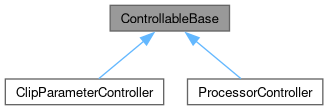
 Inheritance diagram for ControllableBase:
Classes | |
| class | Listener |
| The Listener can subscribe to automation changes, e.g. More... | |
Public Member Functions | |
| ControllableBase (TimeCodeAware &reference) | |
| virtual | ~ControllableBase ()=default |
| virtual double | getCurrentPTS () const =0 |
| Since the automation values are time dependent, every instance, that inherits ControllableBase needs a way to tell the local time (presentation time stamp). | |
| virtual AutomationMap & | getParameters ()=0 |
| Grant access to the individual parameters. | |
| virtual int | getNumParameters () const =0 |
| virtual double | getValueAtTime (juce::Identifier paramID, double pts, double defaultValue)=0 |
| Return the value of the parameter at a certain time point. | |
| void | addListener (Listener *) |
| void | removeListener (Listener *) |
| void | notifyParameterAutomationChange (const ParameterAutomation *p) |
| This notifies all ProcessorController::Listeners about an automation change, so they can adapt accordingly by redrawing the curves or invalidating pre-rendered video frames. | |
| TimeCodeAware & | getTimeReference () |
| Grant access to the time reference of this ControllableBase. | |
| const TimeCodeAware & | getTimeReference () const |
The ControllableBase acts as counterpart to ParameterAutomation.
By inheriting this interface, it is possible to automate things like AudioProcessors or VideoProcessors. But also Clips could have automated parameters, e.g. for geometric information, alpha or an audio gain.
| ControllableBase | ( | TimeCodeAware & | reference | ) |
|
virtualdefault |
|
pure virtual |
Since the automation values are time dependent, every instance, that inherits ControllableBase needs a way to tell the local time (presentation time stamp).
The PTS refers to the audio clock master, video is rendered asynchronously and may have a different PTS
Implemented in ClipDescriptor::ClipParameterController, and ProcessorController.
Referenced by AudioParameterAutomation::parameterValueChanged(), and VideoParameterAutomation::valueChanged().
|
pure virtual |
Grant access to the individual parameters.
Implemented in ClipDescriptor::ClipParameterController, and ProcessorController.
|
pure virtual |
Implemented in ClipDescriptor::ClipParameterController, and ProcessorController.
|
pure virtual |
Return the value of the parameter at a certain time point.
Since the parameter can be used from outside the parameter (i.e. for scale, position etc.) There needs to be a default value, in case the ControllableBase doesn't provide that parameter.
| paramID | the identifier of the parameter |
| pts | the timestamp in seconds in clip time |
| defaultValue | the value that is returned, if the parameter is not set up |
Implemented in ClipDescriptor::ClipParameterController, and ProcessorController.
| void addListener | ( | Listener * | listener | ) |
| void removeListener | ( | Listener * | listener | ) |
| void notifyParameterAutomationChange | ( | const ParameterAutomation * | p | ) |
This notifies all ProcessorController::Listeners about an automation change, so they can adapt accordingly by redrawing the curves or invalidating pre-rendered video frames.
Referenced by ParameterAutomation::addKeyframe(), ParameterAutomation::deleteKeyframe(), ParameterAutomation::setKeyframe(), and ParameterAutomation::setValue().
| TimeCodeAware & getTimeReference | ( | ) |
Grant access to the time reference of this ControllableBase.
| const TimeCodeAware & getTimeReference | ( | ) | const |
 1.9.8
1.9.8